What Are AI Agents? A Complete Beginner's Guide for 2026
10 October 2026 · 11 min read
Vyom Solution
Founder & Lead Designer
Vyom Solution is a web studio based in India, designing and building custom websites for founders worldwide.
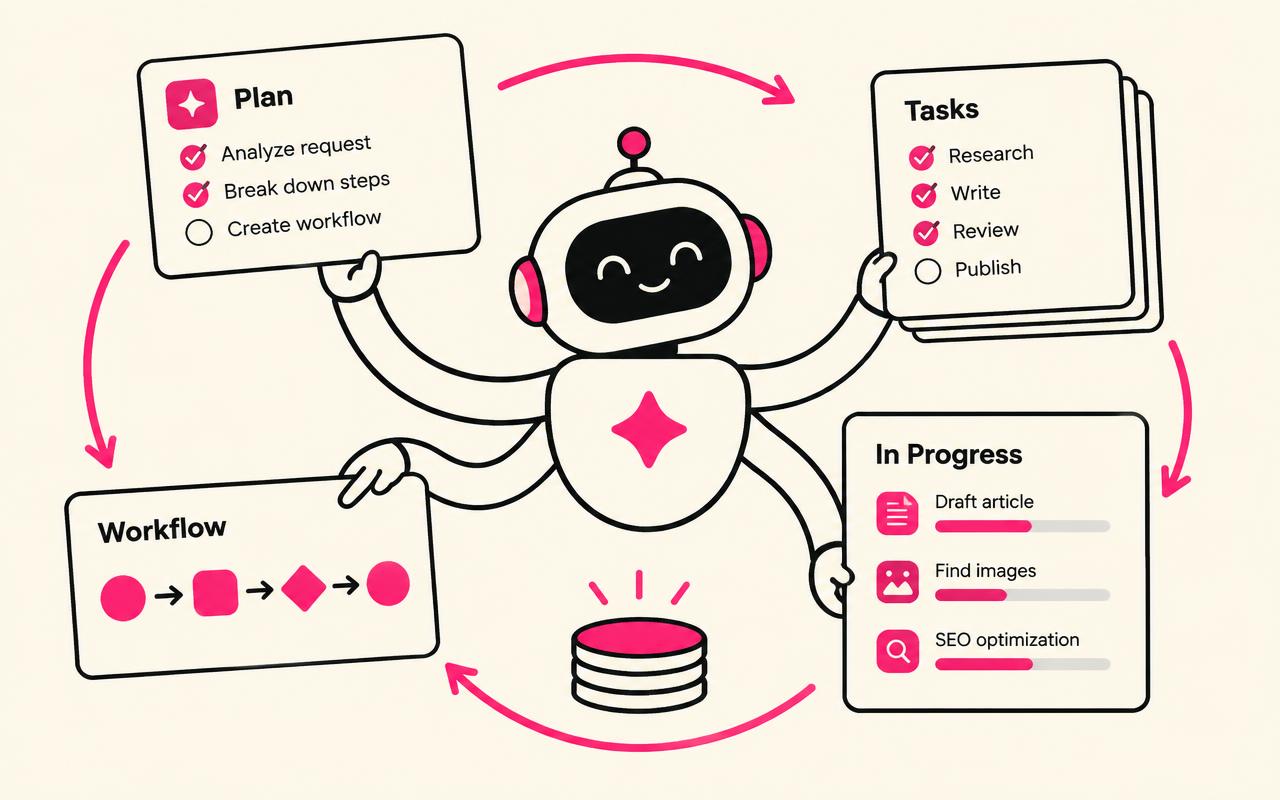
An AI agent is software that takes a goal, decides the steps, uses tools to carry them out, and checks its own work until the job is done. A chatbot replies. An agent acts.
That one difference — from answering to doing — is why every product team is talking about agents. This guide explains the idea in plain language, with a comparison table, a real workflow, and the mistakes to avoid.
▪AI agent vs chatbot vs automation
People mix these three up all the time. They overlap, but they are not the same thing. The easiest way to see the difference is side by side.
| Chatbot | Rule-based automation | AI agent | |
|---|---|---|---|
| Input | A question | A trigger event | A goal |
| Decides steps? | No | No — steps are fixed | Yes |
| Uses tools | Rarely | Pre-wired apps | Chooses tools as needed |
| Handles surprises | Poorly | Breaks | Adapts and retries |
| Best for | FAQs, support | Repeatable tasks | Multi-step, messy work |
▪The four building blocks of every agent
Under the hood, almost every agent is built from the same four parts. Anthropic's write-up on building effective agents is one of the clearest public explanations of this pattern.
- ✓A model — the reasoning engine, usually a large language model (see our AI model comparison)
- ✓Tools — search, email, a calendar, a database, a website API
- ✓Memory — what the agent remembers between steps and sessions
- ✓A loop — plan, act, observe the result, then decide the next step
▪How an agent completes a real task
Say you ask an agent: "Find three cafés in Pune that don't have a website and draft an intro email to each." It searches maps listings, checks each café for a site, writes three personal emails, and hands you drafts to approve. You set the goal; it handled ten small decisions in between.
Connecting agents to tools is getting standardised too. The open Model Context Protocol lets one agent plug into many apps the same way.
▪Where agents work well — and where they don't
Agents shine on tasks that are repetitive but slightly different each time: research, inbox triage, lead qualification, content drafts, report building. They struggle where one wrong action is expensive — payments, legal sign-offs, anything you can't undo. Keep a human approval step there.
| Good fit | Use with care |
|---|---|
| Lead research and enrichment | Sending money or refunds |
| Drafting replies and posts | Publishing without review |
| Summarising documents | Medical or legal advice |
| Updating spreadsheets / CRM | Deleting customer data |
▪Action Steps
- 1
Pick one boring task: choose something you do weekly that takes 30+ minutes.
- 2
Write the goal in one sentence: if you can't, the agent can't either.
- 3
List the tools it needs: email, sheets, your website forms — nothing more.
- 4
Add a human checkpoint: approve before anything is sent or published.
- 5
Measure for two weeks: time saved and errors caught decide if it stays.
▪Frequently Asked Questions
Is an AI agent the same as ChatGPT?+
No. ChatGPT is a chat interface on top of a model. An agent uses a model plus tools and a loop to complete tasks on its own.
Do I need to code to use AI agents?+
Not anymore. Many no-code tools let you build simple agents. Custom agents connected to your own site or data still benefit from a developer.
Are AI agents safe?+
They are as safe as the permissions you give them. Limit tool access, log every action, and keep human approval for anything irreversible.